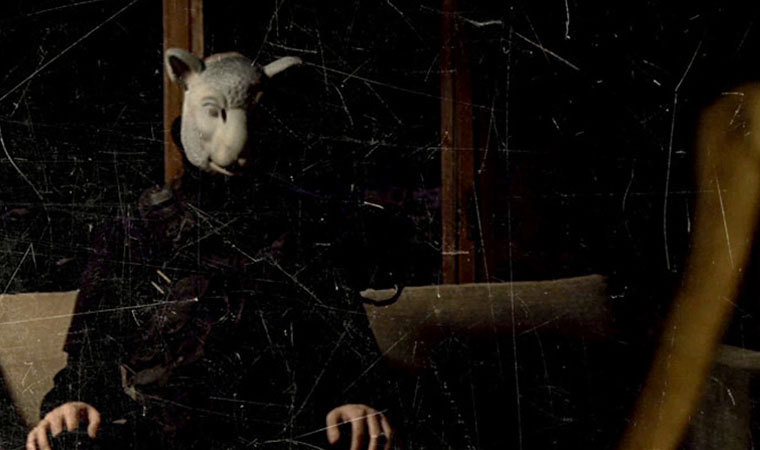
An anniversary dinner should provide a reassuring picture of people who belong together. In You’re Next, the gathering instead gives the audience a set of relationships that are already difficult to manage. The arrival of an outside threat does not replace that difficulty with a simpler story. It increases the pressure on people who have brought their existing habits into the room.
That continuity helps explain the film’s combination of horror and comedy. Its family members do not need to become different people whenever the tone changes. The same desire to dominate a conversation, defend a grievance, or control someone else’s impression can be funny in one moment and dangerous in another. The discussion below includes the film’s setup and the dynamics of its central gathering.
A table organizes people before the camera does
A dining table provides a ready-made social arrangement. People face one another, occupy particular positions, and must negotiate the fact that everyone can hear more than one conversation. Leaving the group can be noticeable. Remaining silent can also be noticeable. Even a restrained scene has several possible centers of attention, because a listener’s reaction may be as revealing as the person speaking.
For a filmmaker, this makes the table both useful and demanding. The setting can establish an ensemble efficiently, but the audience still needs to understand which relationships deserve attention. A line of dialogue gains meaning from the person it addresses, the person it excludes, and the reaction it produces somewhere else in the frame.
The result can be more expressive than a sequence of introductions in which each character takes a turn explaining who they are. At a family dinner, identity is partly relational. People show us who they are by responding to those who already know them.
A reunion is an incomplete explanation
The Film Independent introduction to Simon Barrett and You’re Next presents the anniversary gathering and the family’s arguments as connected parts of the premise. The public setup makes clear that the household’s relationships matter before the masked attackers force everyone to confront a different problem.
That is enough background to enter the scene without requiring a complete family history. A viewer can identify competitiveness, discomfort, and defensiveness through their immediate expression. The film does not have to explain the first occasion on which each disagreement arose. What matters dramatically is that the characters behave as though those disagreements have a history.
This distinction protects the scene from becoming a delivery system for exposition. We are not only collecting information that will be needed later. We are watching people attempt to influence a situation in the present, often with imperfect awareness of how they appear to everyone else.
Performance gives the argument its texture
Written dialogue can establish the direction of a confrontation, but its rhythm depends on performance. An interruption may arrive a fraction earlier than expected. A response may suggest that the speaker has been preparing it for years. A person trying to stay out of an argument can become part of it through a glance or a poorly timed reaction.
In a 2013 interview with Fred Topel, Barrett and Adam Wingard discuss how improvisation developed material already present in the dinner scene’s script. They also describe working with an ensemble that included actors with directing experience. The useful point is not that improvisation replaces writing, but that it can give an established conflict additional behavior.
The scene still requires direction. Overlapping conversation can suggest a believable gathering, yet too much undifferentiated activity makes it difficult to follow a developing argument. A film must decide when to let the room feel crowded and when to isolate a particular exchange for the audience.
Comedy comes from priorities that do not align
One source of uncomfortable comedy is the difference between what a situation requires and what someone insists on making important. At dinner, a comparatively minor slight may occupy a disproportionate amount of attention. The mismatch becomes more severe when an emergency introduces consequences that dwarf the original disagreement.
If a character remains concerned with status while everyone else is responding to danger, the behavior can be absurd without becoming unbelievable. The audience recognizes the habit from the earlier scene. The crisis reveals its persistence instead of inventing it solely for a joke.
This is a different strategy from pausing a frightening sequence to insert an unrelated comic remark. The comic material belongs to the relationships that the film has already established. A laugh can therefore sharpen our understanding of the group, even while the immediate situation remains threatening.
Shared danger does not guarantee cooperation
It is tempting to assume that people facing the same threat will immediately agree on what to do. Drama becomes more interesting when a film recognizes that a shared objective does not produce shared judgment. People can disagree about the available information, trust different voices, or resist a proposal because of who has made it.
The dinner gives those later disagreements a foundation. The audience has already seen how authority circulates in the room. We understand that a sensible suggestion may have to compete with a pattern of resentment or a desire not to appear weak. Cooperation becomes an action characters must achieve, rather than a condition the screenplay grants them automatically.
This is also where the family’s outsider acquires particular importance. Someone who has not spent years participating in the same arguments may see the immediate problem differently. The site’s profile of Sharni Vinson offers background on the performer playing Erin, while Simon Barrett’s profile introduces the writer behind the film’s structure.
Editing can preserve a relationship through chaos
Once a scene becomes more physically complicated, the audience still needs to recognize the people inside it. Clear editing does more than explain where an action occurs. It helps preserve the relationship between a character’s behavior before a crisis and the choices that follow. Without that continuity, an ensemble can become a set of interchangeable reactions.
A useful way to watch the film is to track attention. Who listens to an instruction? Who looks elsewhere? Does a reaction belong to the current danger or to an argument that has not emotionally ended? These distinctions keep the group specific even when the scene’s immediate demands are urgent.
The balance between horror and comedy depends partly on that specificity. A reaction is funnier, more frustrating, or more alarming when it belongs to a recognizable person. The film can shift its emotional emphasis while remaining grounded in behavior the audience has already learned to identify.
The house becomes a social space as well as a location
A country house can provide distance from the outside world, but distance alone does not create an interesting siege. The location becomes more useful when different rooms suggest different kinds of access and belonging. A family member may move through the building with familiarity, while a guest must continually interpret both the architecture and the social situation.
The dining room concentrates these differences. It is a shared space in which everyone is expected to participate, even when their relationships make participation uncomfortable. The attack transforms the room’s practical meaning without erasing what it has already revealed about its occupants.
That is why the domestic premise matters. The story is not simply using an attractive interior as a backdrop for action. It is placing a group of people inside a space that makes their connections visible, then asking what happens when those connections are put under a different kind of pressure.
A tonal shift that keeps its characters intact
You’re Next demonstrates how a film can change the scale of a problem without abandoning its original dramatic material. The family does not stop being a family when the danger arrives. Its habits remain available to the story, producing friction, unexpected humor, and obstacles to practical action.
For viewers interested in craft, the dinner offers a compact study of ensemble storytelling: establish relationships through behavior, give different people competing priorities, and let later events reveal the consequences of those priorities. The comedy becomes more persuasive because it is attached to character, and the horror becomes more specific because the threatened group has already acquired a recognizable identity.
Explore the cast for the people at the table, return to the film’s story for its premise, or continue through Film & Culture for other ways performance, sound, and narrative design shape a film. The dinner matters because it makes the gathering worth watching before survival becomes its only apparent purpose.